The Iran war is hitting the German economy at the worst possible time. Having only just fought its way out of a multi-year downturn, Europe's largest economy is now facing a new external shock — and the picture painted by leading researchers is one of structural exhaustion.
The country's top economic research institutes have more than halved their growth forecasts for 2026 in their Spring 2026 Joint Economic Forecast, published Wednesday.
The report, compiled twice a year on behalf of the Federal Ministry for Economic Affairs, draws on contributions from the German Institute for Economic Research (DIW Berlin), the Ifo Institute and the Kiel Institute for the World Economy, among others.
Iran war halves growth forecast
Where economists were still projecting growth of 1.3% to 1.4% last autumn, the institute now expects GDP to expand by just 0.6% this year and 0.9% in 2027.
Economic output effectively stalled in the first quarter, with the Bundesbank's March monthly report finding that real GDP likely stagnated on a seasonally adjusted basis in the first three months of the year.
"The energy price shock in the wake of the Iran war is hitting the recovery hard, but expansive fiscal policy is supporting the domestic economy and preventing a more severe downturn," said Timo Wollmershäuser, head of economic research at the ifo Institute.
Blocked shipping routes and disrupted energy markets are pushing up commodity and energy prices worldwide, with direct consequences for Germany's energy-intensive industry.
Related
-
This German village relies on renewables to avoid rising energy costs
-
Germany's first Omani LNG shipments arrive despite Middle East disruptions
Inflation on the rise
The price increases are feeding through to consumers. The institutes expect average annual inflation to reach 2.8% in 2026 and 2.9% in 2027.
The Bundesbank warns the rate could climb sharply towards 3% in the near term, driven primarily by higher fuel and heating oil prices.
Should the Strait of Hormuz — the central artery for global oil and LNG trade — remain blocked, upside risks to inflation could be greater still, directly weighing on private consumption that was supposed to anchor the domestic recovery.
While parts of the defence industry and civil engineering are benefiting from government spending, industry as a whole remains sluggish.
Exports are barely growing, held back by weak competitiveness, geopolitical uncertainty and trade policy headwinds.
The Bundesbank notes that low capacity utilisation is compounding the problem.
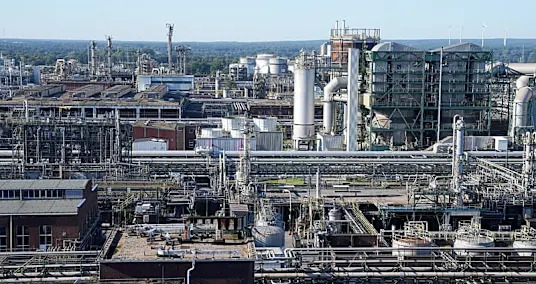
The chemical sector is bearing the sharpest pain. The Hormuz blockade is disrupting supply chains for raw materials that have no short-term substitutes.
latest_posts
- 1
 The Following Huge Thing: 5 Progressive Tech New businesses
 - 2Fossil analysis changes what paleontologists know about how long T. rex took to grow full size
- 3Birds Will Flock To Your Birdbath When You Plant These Two Flowers Around It
- 423 Most Amusing Messages At any point Sent Among Youngsters and Their Folks
- 5Find Unexpected, yet invaluable treasure Excursion Rentals





- Manual for Wonderful Getaway destination
- What is the 'Survivor 50' Challenge? Hidden immunity idols will be up for grabs in every U.S. state.
- Canada cancels its 1st moon rover: 'It's hopefully not a lost cause'
- From invasive species tracking to water security – what’s lost with federal funding cuts at US Climate Adaptation Science Centers
- The most effective method to Help a Friend or family member Determined to have Cellular breakdown in the lungs
- ByHeart sued over recalled formula by parents of infants sickened with botulism
- Find the Advantages of Careful Eating: Developing a Sound Connection with Food
- RFK Jr.'s diet guidelines emphasize red meat, full-fat dairy. How healthy are they?
- Russia downs 16 drones heading for Moscow, mayor says