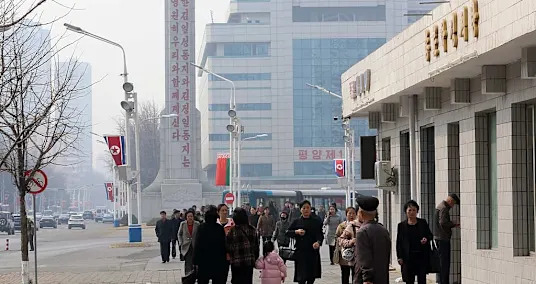
China has announced that its flag carrier, Air China, will resume direct flights to North Korea after a six-year pause, following the restoration of passenger train services between Beijing and Pyongyang.
This marks a significant step toward reopening North Korea, one of the world's most isolated nations, to the world.
Transport links between the two capitals had been suspended since the start of the Covid-19 pandemic in 2020, when Pyongyang implemented a very strict border closure.
While North Korean carrier Air Koryo already resumed flights to Beijing in 2023 and allowed Russian tour groups to visit in 2024, the return of China's air and railways are seen as a major economic milestone, as China has for decades been the main trading partner and a key source of diplomatic and economic backing for the country of 26 million people.
Before the pandemic, there were an estimated 300,000 foreign visitors in 2019, according to South Korea's Institute for International Economic Policy, and Chinese visitors accounted for 90% of all tourists to North Korea. Therefore, the long delay in resuming regular travel had surprised many regional observers.
"The reopening of these borders has been driven primarily by Pyongyang's timeline, which challenges the outdated assumption that Beijing dictates terms to a dependent client state," Seong-Hyon Lee, a visiting scholar at the Harvard University Asia Centre, explains.
Related
Nuclear ambitions complicated the relationship
Despite being Pyongyang’s primary ally, Beijing has frequently voiced disapproval over the North's persistent missile tests and nuclear ambitions. This aspect created a bumpy relationship with Pyongyang, with analysts saying that a nuclear-armed North Korea has often been something of a liability.
The diplomatic normalisation was highlighted last September, when Kim Jong Un attended a massive military parade in Beijing alongside Russian President Vladimir Putin. This was Kim's first appearance at a Chinese military display.
Lim Eul-chul, a North Korea expert at South Korea's Kyungnam University, argues that the war in Iran, in particular, increased "the need for closer coordination between the two nations".
latest_posts
- 1
 WHO suspends Gaza medical evacuations after contractor killed by Israeli troops
 - 2The most effective method to Shield Your Gold Ventures: Procedures and Precautionary measures
- 35 Fundamental Ways to employ a Criminal Legal counselor
- 4Surprise! Saturn's huge moon Titan may not have a buried ocean after all
- 5How to get rid of your Christmas tree — and the 1 thing to never, ever do with it


- IDF carried out mission to locate former hostage Avera Mengistu a day before Oct. 7
- AI is making spacecraft propulsion more efficient – and could even lead to nuclear-powered rockets
- Starbucks' new 'Bearista' cup is causing a stir — and is being listed on eBay for $600
- Novo Nordisk justifies reasoning behind failed GLP-1 Alzheimer's trials
- Interpreter Starts Sobbing as 11-Year-Old Testifies About Last Time He Saw His Mom Before She Was Killed in Missile Strike
- New hybrid mpox strain discovered in UK after US reports local spread
- Burkina Faso forces killed twice as many civilians as jihadists, rights group says
- Bennu asteroid samples provide clues about solar system origins and 'space gum'
- Drones, physics and rats: Studies show how the people of Rapa Nui made and moved the giant statues – and what caused the island’s deforestation