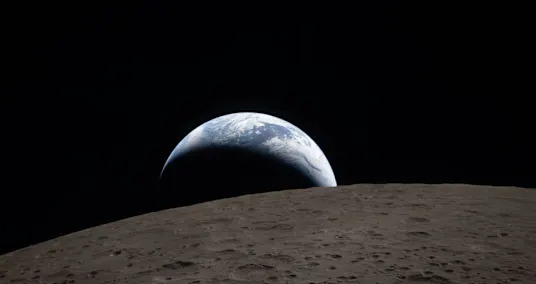
It was a moment for the history books: The Artemis II mission performed its much anticipated lunar flyby yesterday, and came within just 4,067 miles of the moon.
While soaring aboard their Orion capsule beyond the far side of the moon, the crew also reached an estimated 252,756 miles from Earth, breaking Apollo 13’s record for the farthest humans have traveled into space.
The flyby lasted seven hours, during which the astronauts could enjoy views of the lunar surface previously unseen by human eyes, with about 21% of the moon’s mysterious far side illuminated by the sun from the crew’s perspective.
Communications stopped for about 40 minutes during Orion’s transit behind the moon. The crewmembers saw Earth appear to set behind the moon, not dissimilar to what the Apollo astronauts witnessed in 1968. They were also treated to a very special solar eclipse.

After the flyby, Artemis II Commander Reid Wiseman thanked the NASA science team for putting together such an exciting observing program for them, as well as “some great, truly human experience moments here.”
“We were well prepared, and we appreciate all of you, and this is what we do best when we all come together and work as a team,” Wiseman said. “So y’all knocked it out of the park. Thank you for giving us this opportunity.”
Science officer Dr. Kelsey Young shared these comments with the crew: “I can’t say enough how much science we’ve already learned and how much inspiration you’ve provided to our entire team, the lunar science community and the entire world with what you were able to bring today. You really brought the moon closer for us today. And we cannot say thank you enough.”
The crew took thousands of photos that will help inform scientists’ understanding of the moon and its origins — and lay the groundwork for future missions to the lunar surface.
unknown content item
-
“You know from your experience of seeing the Earth from space how it just seems different,” said Canadian Space Agency astronaut Jeremy Hansen, while speaking with NASA Administrator Jared Isaacman about the flyby.
“When we were on the far side of the moon, looking back at Earth, you really felt like you weren’t in a capsule. You’d been transported to the far side of the moon. And it really just bent your mind. It was an extraordinary human experience. We’re so grateful for it.”
For more CNN news and newsletters create an account at CNN.com
latest_posts
- 1
 The Advancement and Effect of Dental Embed Innovation on Oral Wellbeing
 - 2China’s new condom tax will prove no effective barrier to country’s declining fertility rate
- 3Global measles cases drop 71% in 24 years as vaccination coverage improves, WHO says
- 4Daily Briefing: A bad flu season gets worse
- 5The Delight of Perusing: Book Proposals for Each Class


- The Longest Underwater Tunnel Connecting Germany and Denmark
- Vacuum Cleaners That Are Not difficult To Use For Home
- Virtual National Science Foundation internships aren’t just a pandemic stopgap – they can open up opportunities for more STEM students
- Barry Manilow reveals lung cancer diagnosis and plans to undergo surgery: 'It's pure luck' it was 'found so early'
- What's the new 'Knives Out' mystery about? Everything to know about 'Wake Up Dead Man,' including who's in the cast and what the reviews say.
- Creative Do-It-Yourself Ventures for Each Expertise Level
- ‘Dying of thirst’: Inside Gaza’s al-Mawasi water crisis
- Iran steps up executions as experts warn state killing being used to suppress political dissent
- 25 Years Ago, Audi's Rosemeyer Concept Was A Steampunk Supercar With A Massive Engine