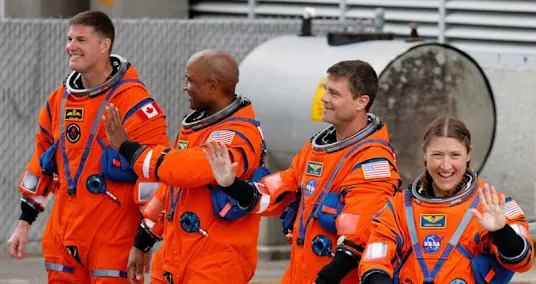
April 1 (Reuters) - All three NASA astronauts on the Artemis II lunar mission are veterans of Earth-orbit science expeditions to the International Space Station, while the lone Canadian joining them on a voyage around the moon and back is a spaceflight rookie.
Here are some highlights from the careers of mission commander Reid Wiseman, pilot Victor Glover and mission specialist Christina Koch, all U.S. astronauts, and Canadian astronaut Jeremy Hansen, also a mission specialist.
MISSION COMMANDER REID WISEMAN
Wiseman, 50, logged 165 days aboard the International Space Station during a 2014 mission, flying to the orbiting platform aboard a Russian Soyuz spacecraft. A former U.S. Navy test pilot, he later served as NASA's chief astronaut before being selected to command Artemis II.
PILOT VICTOR GLOVER
Glover, 49, spent 168 days in orbit beginning in 2020 as pilot of NASA's Crew-1 flight, the first full-fledged ISS mission using SpaceX's Crew Dragon capsule to carry astronauts to the space station. Before joining NASA, he flew more than 40 aircraft during a U.S. Navy career that included combat deployments and test-pilot duties. A veteran of four spacewalks, he is the first Black astronaut ever to be sent on a lunar mission.
MISSION SPECIALIST CHRISTINA KOCH
Koch, 47, set a record in 2019 for the longest continuous spaceflight by a woman, spending 328 days aboard the ISS, and was part of NASA's first three all-female spacewalks. Trained as an electrical engineer and physicist, she previously worked as a NASA engineer and carried out extended research expeditions in Antarctica. She is the first woman to fly on a moon-bound mission.
MISSION SPECIALIST JEREMY HANSEN
Hansen, 50, a Royal Canadian Air Force colonel, is the first Canadian, and first non-U.S. citizen, sent on a lunar mission even as he makes his own first spaceflight. He was selected for Canada's astronaut corps in 2009, and his seat aboard Artemis II reflects a long-standing U.S.–Canadian partnership in human spaceflight, including Canada's contributions to robotics used aboard the ISS.
(Compiled by Joey Roulette in Cape Canaveral, Florida and Steve Gorman in Los Angeles; Editing by Jamie Freed)
latest_posts
- 1
 The Fate of Mechanical technology: 5 Headways Forming Tomorrow
- 2Internet goes (cocoa) nuts: The funniest reactions to 12 tonne theft of KitKat bars
- 3Good ways to respond if your kid brings home less-than-ideal grades
- 4Pick Your Favored kind of soup
- 5Shelby County deputies charged with assault, placed on leave





- SpaceX rocket launches 140 satellites into orbit on Transporter-15, aces landing at sea (video)
- Flu season is underway. What are common symptoms to watch for?
- Vote In favor of Your Favored Pet Consideration Administration
- Interstellar comet 3I/ATLAS will fly by Earth Friday. Here are the latest images
- From invasive species tracking to water security – what’s lost with federal funding cuts at US Climate Adaptation Science Centers
- Only 30% of young people in Israel optimistic about future, Aluma survey reveals
- AI’s errors may be impossible to eliminate – what that means for its use in health care
- College students are now slightly less likely to experience severe depression, research shows – but the mental health crisis is far from over
- Pick Your Favored kind of books