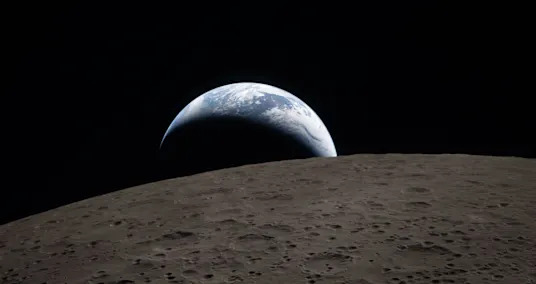
For the first time ever, humans have glimpsed the entire far side of the moon with their own eyes — and their photos are beginning to come in.
In what was the most highly anticipated moment of the Artemis II mission, four astronauts flew around the moon Monday, snapping photos and making detailed observations out the window of their Orion spacecraft.
NASA astronauts Reid Wiseman, Victor Glover and Christina Koch and Canadian astronaut Jeremy Hansen captured a slew of photos of the moon’s rugged terrain, sprawling impact craters and vast, dark plains.

Wiseman, Glover, Koch and Hansen spent around seven hours taking photographs and gathering notes about surface features on the moon during the flyby. They became the first people to see the lunar far side, which is not visible from Earth because that part of the moon permanently faces away from our planet.
Even during the Apollo missions, astronauts couldn’t view much of the moon’s far side because of the paths and timing of their flights.
Now, the four Artemis II astronauts have become trailblazers for all of humanity.
Their early observations elicited celebrations from the mission's lunar science team throughout the flyby. Glover, for instance, was particularly captivated by the jagged topography along the moon’s terminator, the dividing line between its illuminated side and the side cloaked in darkness.
“Boy, I am loving the terminator,” he radioed to Mission Control. “There’s just so much magic in the terminator — the islands of light, the valleys that look like black holes. You’d fall straight to the center of the moon if you stepped in some of those. It’s just so visually captivating.”

Throughout the day, the astronauts spoke about how moving it was to see the moon up close.
“When we have that perspective and we compare it to our home of Earth, it just reminds us how much we have in common,” Koch said. “Everything we need, Earth provides. And that is somewhat of a miracle and one that you can’t truly know until you’ve had the perspective of the other.”

The four crew members spent hours marveling over the moon’s brightness, colors and surface features, radioing vivid descriptions in real time to mission controllers in Houston.
They reported seeing brown and green hues on the near side of the moon and noted the brightness of small, new craters that were most likely created by recent meteorite impacts.
Those observations will be important for lunar and planetary scientists. NASA has said the Artemis II images of craters, ridges and ancient lava flows on the lunar surface could help researchers better understand how the moon — and the solar system — formed.

During the flyby, the Artemis II astronauts set a record for venturing farther from Earth than any other humans. As they swung around the moon, they flew 252,756 miles from our home planet, more than 4,100 miles farther than the Apollo 13 astronauts did in 1970 on their emergency return home.
NASA plans to publicly release the full set of moon photos taken by the Artemis II astronauts, but because of downlink limitations, the bulk will not be retrieved and processed until after the astronauts return to Earth.
Wiseman, Koch, Glover and Hansen will spend the next three days journeying home. They are scheduled to re-enter Earth’s atmosphere and splash down in the Pacific Ocean off San Diego on Friday.
This article was originally published on NBCNews.com
latest_posts
- 1
 The 10 Most Persuasive Forerunners in Innovation
- 2Extravagance SUVs for Seniors: Solace, Innovation, and Security
- 3Haunting Giant Squid Surfaces in Japan and Devours Its Prey (Video)
- 4IDF carried out mission to locate former hostage Avera Mengistu a day before Oct. 7
- 5Venus shines at its best in spring and summer 2026 — here's what to look for



- Iran plans new restrictions in overhaul of Strait of Hormuz rules
- My prescription costs what?! Pharmacists offer tips that could reduce your out-of-pocket drug costs
- 'Inflaming tensions': Bedouin mayor slams Ben-Gvir's unauthorized visit after meeting cancellation
- ONE returns to Red Sea with new service
- The most effective method to Guarantee Thorough Inclusion in Senior Protection.
- From Iran to Israel: An Iranian volunteer’s unlikely stand in wartime
- Nearly 16,000 New York City nurses prepare to strike as contract talks stall
- Dinosaur collagen used to create one-of-a-kind handbag
- Reconnecting with an old friend is a story of distance, loss and rediscovery